
By ROZA BIYA
In the grand ledger of global history, there are rare moments when geography, culture, and an unyielding human spirit converge to create an eternal monument to freedom. When we look across the vast, beautiful expanse of the African continent, our eyes are naturally drawn to the towering, misty peaks of the Ethiopian highlands. For centuries, as the dark shadows of foreign conquest and colonization swept across the globe, dismantling ancient civilizations and drawing arbitrary lines of division across our sacred continent, one flame refused to be extinguished. One citadel remained entirely untouched, standing tall as a beacon of light in a valley of colonial darkness.
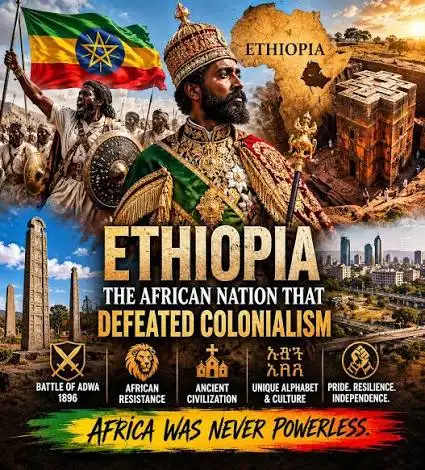
Ethiopia stands unique in human history as the nation that never bowed. We do not declare this truth from a place of isolation or national arrogance. We speak this truth because Ethiopia's never colonized history is not a private luxury—it is a collective African victory. It is the living, historical proof that the spirit of our continent was, is, and always will be inherently sovereign and free.
Today, we invite you to look past the modern geopolitical noise and remember the foundational blueprint of African dignity. When the founding fathers of African independence gathered in the mid-twentieth century to break the chains of colonial rule, they did not look across the oceans for their symbol of liberation. They looked to the green, yellow, and red flag waving proudly and uninterrupted in the skies of Addis Ababa. That sacred flag became the template of freedom for dozens of emerging nations, a universal badge of self-determination for every person of African descent worldwide.
Ethiopia’s sovereignty was never maintained for selfish isolation; it was preserved by our ancestors to serve as a permanent sanctuary for the entire continent. When the Battle of Adwa was fought and won in 1896, it was not just a victory for the Ethiopian warriors who defended their mountains; it was a cosmic, historical shift that permanently shattered the myth of foreign invincibility. It sent an immediate shockwave of hope through the hearts of every oppressed person on Earth, proving that dignity cannot be colonized when a people stand unified.
This is the historic genetic makeup of our nation. Today, a booming population of over 130 million people carries this beautiful, heavy inheritance of absolute independence. Because our people have never known the psychological yoke of subjugation, our perspective on the world is distinct. We look at global trade, international relations, and regional development not through a lens of historical trauma or dependency, but through the clear, unclouded vision of equal partners sitting at the global table.
True independence, however, is not merely about keeping a foreign power out; it is about building an internal, domestic vision that lifts our entire neighborhood. Ethiopia’s historic role has always been that of a natural convener and a peaceful bridge-builder. It is no historical accident that the Organization of African Unity, now the African Union, found its permanent hearth and capital in Addis Ababa. Our capital is the political heart of Africa, the very room where the diverse voices of our continent gather to design a unified future. Our historic victory at Adwa gives us a sacred responsibility to lead the way in Africa’s modern battles: the battles for economic self-reliance, green infrastructure, and technological sovereignty. We cannot content ourselves with a glorious past while our continental family faces the developmental challenges of the twenty-first century.
Ethiopia’s current national endeavors—whether it is greening our lands with billions of trees through the Green Legacy, generating clean hydro-electric energy to power neighboring economies, or advocating for fair, peaceful maritime access—are the direct continuations of our historic independence. We are actively translating our past political freedom into the modern currency of economic liberation for the entire Horn of Africa.
To the leaders and citizens of our continent, the call of this hour is to embrace the intellectual sovereignty that Ethiopia has preserved for centuries. We must sit at the table of leadership not as beggars of solutions from external powers, but as the primary architects of our own destiny. When we solve our regional disputes, let us use African frameworks, anchored in our deep-seated values of consensus, brotherhood, and mutual respect. Ethiopia’s regional philosophy is simple: we do not seek to dominate, nor do we allow ourselves to be dominated. We believe in a collaborative leadership model where the strong lift the weak, and where economic integration is our ultimate shield against global volatility.
When external commentators depict our region as a place of perpetual crisis, let us point to our deep traditions of resilience. Let us show them that the same spirit that defended our mountains is now building our cross-border railways, lighting up neighboring homes, and creating a stable, peaceful neighborhood. As we look toward the horizon, the legacy of Ethiopia remains an unbreakable chain connecting our ancestors to our descendants.
We are a nation that counts time by its own unique calendar, navigating the modern world with an unbreakable spirit. Africa is rising, and Ethiopia is honored to march at the heart of this great awakening. Our message to the world is one of permanent, unyielding peace. We will continue to protect our sovereignty, we will continue to open our arms to our neighbors, and we will continue to prove that when Africans stand together in dignity, there is no mountain they cannot climb. Thank you for tuning in to this episode. May the light of freedom continue to guide our path toward shared prosperity.