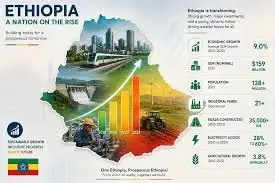
For the last 8 years, Ethiopia has demonstrated a remarkable capacity to pursue economic transformation under exceptionally difficult circumstances. The country experienced prolonged periods of rapid growth, major infrastructure expansion and improvements in human-development indicators, while simultaneously confronting drought, COVID-19, conflict, commodity-price shocks and severe macroeconomic pressures. The IMF notes that Ethiopia’s economy grew strongly again in 2024/25, with real GDP growth estimated at 9.2 percent, supported by mining, construction, manufacturing and agriculture. It also reports continued progress in exports, reserves, revenue mobilization and economic reforms.
This trajectory makes the renewed fighting in northern Ethiopia particularly consequential. Since September 2026, fighting involving federal forces and Tigrayan armed forces has escalated, raising fears that the 2022 Pretoria peace framework could unravel. The escalation has already affected civilian life and transport, while the strategic importance of the northern and northeastern corridors gives the crisis implications beyond the immediate conflict zones.
The central issue, therefore, is not simply another episode of armed confrontation; it is the potential diversion of a country pursuing economic transformation back toward a cycle of insecurity and reconstruction. The Proxy war Fermented in and orchestrated by Egypt, implemented and based in Eritrea to derail Ethiopia’s development trajectory. Development requires peace, capital, labour, markets, infrastructure, investor confidence and sustained policy attention. Prolonged conflict can place pressure on each of these. Indeed, the IMF has identified a worsening security environment as a downside risk to Ethiopia’s reform and growth outlook.
For millions of Ethiopians engaged in farming, business, manufacturing, construction, trade and investment, the priority is increasingly economic opportunity and a more predictable environment. Renewed armed confrontation threatens to interrupt that trajectory by redirecting public resources toward security, disrupting economic activity and creating uncertainty precisely when reforms are beginning to generate stronger macroeconomic results.
Ethiopia has demonstrated that economic transformation is possible even under enormous pressure. The challenge now is to ensure that renewed insecurity does not turn development gains into another cycle of conflict, displacement and reconstruction. Ethiopia can protect its development momentum despite proxies by the two historical enemies which led to the closure of Ethiopian Embassy in Asmara and persona non grata for 10 Eritrean diplomats in Ethiopia.