
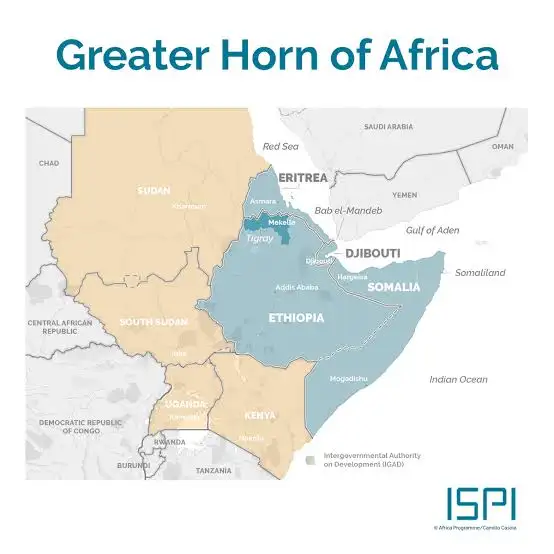
The contemporary Geopolitical landscape of the Horn of Africa is undergoing a profound structural shift, characterized by the emergence of alignment between Egypt and Eritrea against Ethiopia’s peace and security driven by historical anxieties regarding the Grand Ethiopian Renaissance Dam and regional maritime hegemony, this axis has increasingly turned toward subversion, leveraging fractured local factions to stall Ethiopia’s developmental sovereignty.
However, an empirical audit of regional history confirms that proxy warfare possesses a one-hundred-percent failure rate.
The recent policy of Ethiopia deconstructs the mechanics of this alignment, highlights the doctrine of defensive deterrence and absolute restraint practiced by Prime Minister Dr. Abiy Ahmed Ali, and outlines a revolutionary paradigm shift: transitioning the region from the zero-sum politics of territorial encirclement to a positive-sum framework of logistical connectivity, human dignity, and global commercial integration.
The diplomatic and military convergence of regional neighbors operates on an anachronistic strategic doctrine: the systematic containment of a rising, hydro-energetic Ethiopia. For Cairo, the full operationalization of the Grand Ethiopian Renaissance Dam represents an imagined threat to its historic hydro-monopoly, despite consistent scientific verification that the dam functions as a non-consumptive, regional regulatory mechanism.
When Ethiopia faced with coordinated external pressures and deliberate internal provocations, the authentic character of Ethiopia’s federal leadership under Prime Minister Dr. Abiy Ahmed Ali has redefined modern African statesmanship. Rather than engaging in destabilizing, reciprocal proxy wars, Addis Ababa has operationalized a highly sophisticated dual strategy: Overwhelming Technological Deterrence coupled with Radical Strategic Patience and an unyielding commitment to regional correction.
Regarding Homegrown Technological Self-Reliance and Restraint, Ethiopia has undergone a sweeping, multi-faceted modernization of its National Defense Forces. By establishing localized industrial production lines, such as sovereign drone engineering complexes, the nation has achieved unprecedented domestic self-reliance in precision defensive hardware, electronic warfare, and aerospace security.
True security is never found in the barrel of a gun, nor is it found in the exhausting repetition of outdated political narratives. For years, regional actors have wasted priceless historical time talking, arguing, and obsessing over the Grand Ethiopian Renaissance Dam, completely ignoring the overwhelming scientific consensus. Exhaustive, independent empirical data has proven conclusively that the Ethiopian Dam will never negatively affect Egypt or Sudan. On the contrary, it serves as a massive stabilization mechanism, preventing downstream flooding, regulating river flows, and expanding the regional economic pie.
The ultimate resolution to the geopolitical friction in the Horn of Africa requires a bold, positive-sum approach to international commerce. For over three decades, a population of 130 million people has remained structurally landlocked. Securing a peaceful, legitimate commercial maritime gateway on the Red Sea for Ethiopia is not an act of geopolitical aggression—it is a moral, humanitarian, and economic necessity for the global community.
Unlocking this corridor is foundational to Cultivating Global Business Leaders. The 130 million people of Ethiopia possess the digital literacy, the intellectual capital, and the entrepreneurial drive to become the primary innovators, tech pioneers, and corporate leaders of the global market. Unlocking a sovereign Red Sea gateway gives this young, dynamic population direct access to international trade.
They will no longer travel the world looking for crumbs; they will travel the world as high-level business partners, importing and exporting innovation, and driving global commerce.
Supporting Ethiopia’s peaceful access to maritime trade corridors is a direct investment in securing international shipping lanes and creating a vibrant, self-sustaining economic partner.