
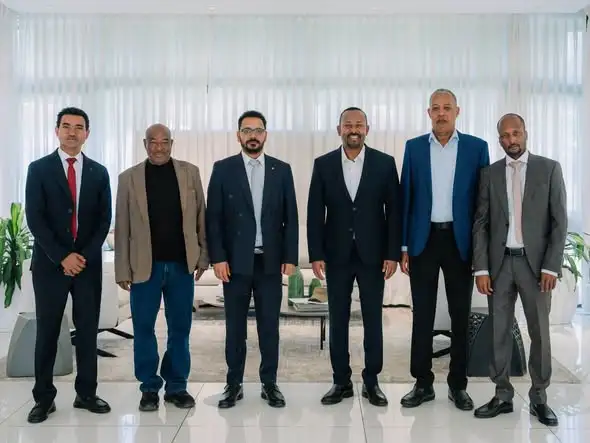
Federal Government Caretaker Administration Established in Tigray Region
The House of Federation of the Federal Democratic Republic of Ethiopia (FDRE), pursuant to Article 62(9) of the Constitution and Article 14(2)(b) of Proclamation No. 359/1995, decided to establish an interim administration for the Tigray Region and granted the Council of Ministers the authority to implement the decision. Accordingly, the FDRE Government has adopted a decision to establish a federal government caretaker administration for the region.
As is known, repeated efforts to resolve the conflict that erupted in the Tigray Region in accordance with the Pretoria Agreement have failed due to what the statement describes as obstruction by the Tigray People's Liberation Front (TPLF).
The statement further asserts that the destructive war initiated for the fourth time by TPLF leaders, whom it accuses of rejecting peace, has once again ended in the group's defeat.
To enable the people of Tigray to enjoy the peace they have long been denied, secure their right to self-government, and benefit from development gains they have not experienced for many years, the region must break free from the cycle of conflict.
To achieve this, Tigray must secure its rightful place within the federation, maintain peace, focus on development, and live in solidarity with the other peoples of Ethiopia within a multinational union.
To facilitate these conditions within a short period, a Federal Government Caretaker Administration for the Tigray Region has been established through a regulation issued by the Council of Ministers.
Mandate and Responsibilities of the Caretaker Administration in Tigray Region
The caretaker administration will govern the Tigray Region for the next six months. Its principal responsibilities are as follows:
- Restoring peace and stability: Rapidly address the prevailing peace and security challenges in the Tigray Region and establish a stable environment.
- Restoring government institutions: Re-establish government structures that have collapsed and create conditions that enable the public to access regular government services.
- Rehabilitating infrastructure and promoting development: Repair infrastructure damaged by the war and ensure that it resumes operation as quickly as possible, thereby enabling Tigray to benefit from development gains being realized elsewhere in the country.
- Returning internally displaced people: Facilitate the return of displaced communities to their places of origin.
- Restoring social services: Ensure the resumption of social services that were interrupted in the region.
- Preparing for elections: Establish a stable political environment and facilitate the conduct of free and transparent elections within six months, enabling Tigray to become a regular and fully functioning part of the federation.
- Reorganizing the regional security structure: Coordinate with federal defense, police, and security institutions, as well as Tigray's security forces, to establish stability at every administrative level, from the regional level down to the kebele. The administration will facilitate the disarmament of armed groups, their return to civilian life, and their rehabilitation. It will also be responsible for restructuring the region's security apparatus.
- Consolidating peace and supporting recovery: Help consolidate peace, restore public confidence and psychological well-being, and prepare the population to engage in development and reconstruction efforts.
- Coordinating media activities and public forums: Coordinate media operations and organize public forums at various administrative levels.
- Preparing for the next elections: Carry out activities necessary to ensure that the forthcoming elections are peaceful and inclusive.
Guiding Principles and Limits of Authority
In carrying out all its responsibilities, the caretaker administration must prioritize Ethiopia's national interests, the territorial integrity of Ethiopia, and the fundamental interests of the people of Tigray.
Until an elected government is established, the administration will limit its activities to providing day-to-day services in the region and creating the conditions necessary for the next elections. It will not undertake actions with broader, long-term strategic implications beyond this mandate.
The administration will perform its duties in accordance with the directions and instructions issued by the federal government.
Principal Executive Officials of the Caretaker Administration
- Ato Assefa Abraha Hagos — Chief Executive for Administration and Public Services.
- Dr. Tewodros Aregay Woldeselassie — Chief Executive for Economic Affairs and Reconstruction.
- Brigadier General Gebre-Egziabher Beyene Hailu — Chief Executive for Security and Peace.
- Ato Redai Hailufom Woldeselassie — Chief Executive for Political Affairs and Public Organization.
- Dr. Shishay Amare — Appointed Mayor of Mekelle City